The Frosted Bottle: Reading Your CBD Oil Through a UK Cold Snap
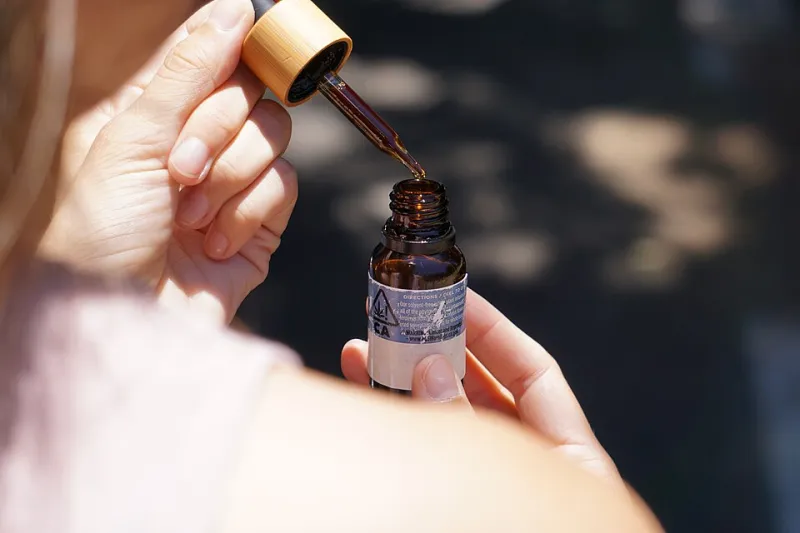
Photo: elsaolofsson, CC BY 2.0, via Wikimedia Commons
There’s a particular moment in a UK cold snap when you reach for your evening dropper and the bottle feels different. Maybe it’s been sitting on the kitchen windowsill beside a half-dead basil plant. Maybe the radiator in the back room hasn’t kicked in yet. Either way, the oil that ran freely in October now moves like something closer to honey — or it’s gone cloudy, or there’s a little ring of pale fat near the shoulder of the bottle. Before you panic and bin it, take a breath. In most cases, your CBD oil hasn’t spoiled. It’s just responding to the cold.
Why your oil has gone quiet
Most UK CBD oils are built on a carrier oil, and the carrier is doing a lot of the work here. Coconut oil — including the MCT fraction many brands use — and shea-based blends are common because they’re pleasant to hold under the tongue and they carry cannabinoids well. But they also have a habit of solidifying at cooler temperatures. Coconut oil, for instance, starts to firm up somewhere around 24°C and below. A chilly kitchen, a cold windowsill, or a parcel left on the doorstep for an hour can all nudge a bottle into that thicker state.
That’s not a defect. It’s chemistry. If your oil is labelled as full-spectrum, broad-spectrum or isolate, the cannabinoid content isn’t necessarily changing just because the texture has. The carrier oil is simply showing you what it does when the temperature drops.
The harmless trio: cloud, thickness, a little separation
There are three cold-weather changes that are usually nothing to worry about. The first is cloudiness — a soft haze that appears when the oil gets cold. The second is thickening, which can make a dropper draw more slowly or leave a slightly waxy film on the glass. The third is mild separation: a thin, pale layer or tiny flecks of solidified fat that appear near the top or bottom of the bottle.
Coconut oil and shea butter are both prone to this. They contain natural fats that solidify at different temperatures, so a chilled bottle can look uneven for a while. If the oil returns to a smooth, even texture once it’s warmed gently, that’s a reassuring sign. Many good oils will do exactly that.
How to warm a chilled bottle without wrecking it
The goal is gentle, even warmth — not a blast of heat. Cannabinoids are generally robust, but nobody benefits from a bottle that’s been left on a radiator or zapped in a microwave. Here’s a simple routine:
- Start with your hands. Roll the bottle between your palms for a minute or two. This is slower than a water bath, but it’s kind to the oil and surprisingly effective for small bottles.
- Use a warm water bath if needed. Stand the sealed bottle in a bowl of warm — not hot — water for a few minutes. Think bathwater you’d be happy to wash your hands in, not a rolling boil. Swirl gently every so often.
- Avoid direct heat. Radiators, hobs, microwaves and sunny windowsills are all too much. They can heat the oil unevenly and make the bottle uncomfortable to handle.
- Shake gently, don’t foam. Once the oil has loosened, roll or invert the bottle a few times. You’re looking for an even texture, not a cocktail shake.
If the oil clears and flows normally after that, you’re almost certainly fine to carry on as usual.
When to look closer
There are times when a cold-weather change deserves a second look. If the oil stays grainy after gentle warming — not just cloudy, but persistently gritty or lumpy — that’s worth noting. The same goes for a separation that won’t resolve, a sharp or rancid smell, a leaking seal, or any sign of mould. Those aren’t normal cold-snap behaviour.
It’s also worth checking the label. Some oils are formulated to stay liquid at room temperature, and a bottle that turns solid at seven degrees might simply be a different carrier blend than you expected. That’s not automatically bad, but it can affect how easily you dose. If you rely on a precise number of drops, a thick oil can make that trickier. In that case, warming it gently before each use is part of the routine, not a red flag.
A small note on storage through the cold months
You don’t need to baby your CBD oil, but a little consistency helps. Keep it out of direct sunlight and away from radiators, and try to store it somewhere with a fairly steady temperature — a cupboard rather than a windowsill is a good start. If your kitchen is genuinely cold, a closed drawer or a shelf away from the exterior wall will do. And if you decant into a smaller bottle for travel, expect the same cold-weather behaviour. It’s the carrier oil, not the journey.
In short: a cloudy, thick or slightly separated CBD oil in a cold snap is usually just a bottle telling you it’s chilly. Warm it gently, give it a slow roll, and see how it settles. If it comes back smooth, you’ve probably found a perfectly good gem that simply needed a bit of warmth.